
Chess Board Setup Trainer: Correct Starting Position
The fastest way to check a chess board setup is simple: light square on the right and queen on her own color. Use the interactive trainer below to confirm orientation, queen squares, and the full starting position before you play.
Correct setup in one glance
The correct chess board setup starts with a light square in the bottom-right corner from each player’s side. Then place rooks in the corners, knights next to rooks, bishops next to knights, queens on their own color, kings on the remaining central square, and pawns on the second rank for White and seventh rank for Black.
Orientation: bottom-right square is light.
Queen rule: White queen on d1, Black queen on d8.
King squares: White king e1, Black king e8.
First move: White always moves first.
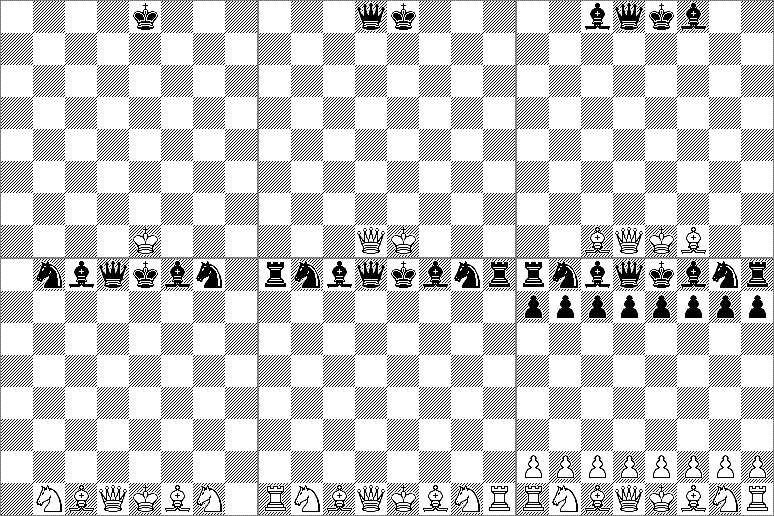
Many setup mistakes come from rotating the board the wrong way. Check the corner square first, then place the pieces.
Interactive setup checker
Use this quick checker to verify the exact thing you are unsure about: board orientation, queen squares, or the whole starting position.
How to set up a chess board correctly
Follow this order and you can set up a chess board correctly in under a minute, even if you are completely new to the game.
- Orient the board first. The bottom-right corner square must be light.
-
Place all pawns.

 White pawns go on rank 2 and Black pawns go on rank 7.
-
Put rooks in the corners.

 They start on a1 and h1 for White, and a8 and h8 for Black.
-
Place knights next to the rooks.

 They start on b1 and g1 for White, and b8 and g8 for Black.
-
Place bishops next to the knights.

 They start on c1 and f1 for White, and c8 and f8 for Black.
-
Put each queen on her own color.

 White queen starts on d1 and Black queen starts on d8.
-
Put the king on the remaining central square.

 White king starts on e1 and Black king starts on e8.
- Start the game with White to move. White always makes the first move.
Common mistake: rotating the board so a dark square is on the bottom-right.
Second common mistake: swapping the king and queen.
Fast correction: rotate the board first, then reset only the king and queen if needed.
Back-rank piece order
Once the board is facing the right way, the back-rank pattern becomes easy to remember.
White back rank: rook, knight, bishop, queen, king, bishop, knight, rook.
Black back rank: rook, knight, bishop, queen, king, bishop, knight, rook.
Pawn row: eight pawns directly in front of the pieces.
Anchor squares: queens on d1 and d8, kings on e1 and e8.
- Rooks always begin in the corners.
- Knights always begin next to the rooks.
- Bishops always begin next to the knights.
- The queen and king occupy the two center files.
Files and ranks explained
Files are columns and ranks are rows. This matters because many beginners search for square names like d1, e1, or h1 when checking setup.
The red arrow shows a file and the blue arrow shows a rank.
- Files: vertical columns labeled a through h.
- Ranks: horizontal rows numbered 1 through 8.
- Example: d1 means file d, rank 1.
- Useful setup squares: White queen d1, White king e1, Black queen d8, Black king e8.
Setup basics
What is the correct chess board setup?
The correct chess board setup starts with a light square in the bottom-right corner from each player's side, with rooks in the corners, knights next to rooks, bishops next to knights, queens on their own color, kings on the remaining central square, and pawns in front. The full starting pattern is symmetrical apart from the color of the pieces and the fact that White begins on ranks 1 and 2 while Black begins on ranks 7 and 8. Use the interactive setup checker above to confirm the full starting position square by square.
How do you set up a chess board correctly?
To set up a chess board correctly, orient the board first, then place pawns, then rooks, knights, bishops, queens, and kings. The order matters because most mistakes come from a rotated board or from swapping the king and queen after the back-rank pieces are already down. Follow the step-by-step setup section on the page to place everything in the right order.
What is the starting position in chess?
The starting position in chess is the arrangement where every piece begins on its home square before any move has been played. White's pieces fill ranks 1 and 2, Black's pieces fill ranks 7 and 8, and the queens start on d1 and d8 while the kings start on e1 and e8. Use the full setup view in the checker to compare your board against the standard starting position.
Who moves first in chess?
White moves first in chess. That rule is fixed in standard chess and is part of the official starting position, not a casual house choice. Use the setup guide on the page to get the board right first, then begin with White to move.
How many pieces are on the board at the start of a chess game?
There are 32 pieces on the board at the start of a chess game. Each side has 16 pieces made up of 8 pawns, 2 rooks, 2 knights, 2 bishops, 1 queen, and 1 king. Use the full setup checker to make sure all 32 pieces are present and placed on the right starting squares.
How many pawns does each side start with in chess?
Each side starts with 8 pawns in chess. All eight pawns form a complete row in front of the back-rank pieces, with White on rank 2 and Black on rank 7. Use the setup steps above to place the pawn row first if you want the quickest clean build.
Orientation and board direction
Which way should a chess board face?
A chess board should face so that each player has a light square in the bottom-right corner. This is the fastest orientation test because it works before you place a single piece and prevents the most common beginner setup error. Use the orientation view in the interactive checker to verify the corner square instantly.
Is white on the right in chess?
Yes, white on the right means the square in the bottom-right corner from each player's side is a light square. The phrase refers to the color of the square, not to the side that White sits on or the color of the pieces themselves. Use the checker above to see that bottom-right light-square rule visually.
What does white on right mean in chess?
White on right means the bottom-right corner square must be a light square when you sit behind your pieces. It is a memory shortcut for board orientation and helps stop the king and queen from ending up on the wrong files. Use the orientation checker on the page to lock that visual rule in quickly.
What happens if the chess board is set up the wrong way?
If the chess board is set up the wrong way, the whole starting position becomes wrong even if the pieces seem neatly arranged. A rotated board usually causes the queen and king files to be reversed relative to the correct square colors, which breaks the standard setup. Use the orientation check first, then compare your board with the full setup view to correct it.
Can you set up a chess board the same way in the UK?
Yes, a chess board is set up the same way in the UK as everywhere else in standard chess. The rules for orientation, queen placement, and White moving first are international and do not change by country. Use the same light-square-on-the-right test shown in the checker wherever you play.
Does it matter which side of the board you sit on?
Yes, it matters because each player should sit behind one army with the pieces nearest to them. The orientation rule is checked from your own side, so the bottom-right square must be light from where you are sitting. Use the board image and setup checker to confirm the board from the player's viewpoint rather than from the side.
King and queen confusion
Does the queen go on her own color in chess?
Yes, the queen goes on her own color in chess. The White queen starts on d1, which is a light square, and the Black queen starts on d8, which is a dark square. Use the queen-square view in the checker to confirm both queen starting squares at once.
Does the king or queen go on its own color?
The queen goes on her own color, not the king. Once the queen is placed correctly, the king automatically takes the remaining central square beside her. Use the queen check above first, then the full setup view to place both royal pieces correctly.
Where does the white queen start?
The White queen starts on d1. That square is a light square, which matches the rule that the queen starts on her own color. Use the queen-square checker on the page to confirm d1 before placing the White king on e1.
Where does the black queen start?
The Black queen starts on d8. That square is a dark square, which matches the same queen-on-her-own-color rule used for White. Use the queen-square checker to verify d8 before placing the Black king on e8.
Where does the king start in chess?
The White king starts on e1 and the Black king starts on e8. The king always goes on the remaining central square after the queen has been placed on her own color. Use the full setup display to check the king squares against the queen squares together.
Why do beginners mix up the king and queen squares?
Beginners mix up the king and queen squares because both pieces start in the center and look like a pair. The real anchor is the queen-on-her-own-color rule, which fixes d1 and d8 first and leaves e1 and e8 for the kings. Use the queen-square check before anything else if this is the mistake you keep making.
Piece placement and order
Where do the pawns go in chess setup?
The pawns go in a full row directly in front of the main pieces. White pawns start on rank 2 and Black pawns start on rank 7, creating the front line for each side. Use the setup steps on the page to lay the pawn rows down before filling the back rank.
Where do the rooks start in chess?
The rooks start in the four corner squares. White rooks begin on a1 and h1, while Black rooks begin on a8 and h8, which makes them easy anchor pieces for the edges of the back rank. Use the piece-order box on the page to confirm the corner pattern before placing the inner pieces.
Where do the knights start in chess?
The knights start next to the rooks. White knights begin on b1 and g1, and Black knights begin on b8 and g8, making them the second pieces in from each side on the back rank. Use the back-rank order section on the page to keep the rook-knight-bishop pattern straight.
Where do the bishops start in chess?
The bishops start next to the knights. White bishops begin on c1 and f1, and Black bishops begin on c8 and f8, leaving the queen and king in the two middle files. Use the piece-order section to check the full back-rank pattern from rook to rook.
What is the back-rank order in chess?
The back-rank order is rook, knight, bishop, queen, king, bishop, knight, rook from left to right on each side. That pattern is mirrored for both colors once the board is oriented correctly and the queen is put on her own color. Use the back-rank box on the page to compare your first rank or eighth rank against the standard order.
Do both sides have the same piece order in chess setup?
Yes, both sides have the same piece order in chess setup. The order is symmetrical across the board, but the piece colors and starting ranks differ, with White below and Black above. Use the full setup view to see that both armies follow the same rook-to-rook pattern.
Can you place the pieces in any order when setting up a chess board?
Yes, you can physically place the pieces in any order as long as the final position is correct. In practice, it is easier to orient the board first and then build from pawns, corners, and center pieces because that reduces mistakes. Use the step-by-step section if you want the cleanest beginner-friendly setup order.
Files, ranks, and square names
How many squares are on a chess board?
A chess board has 64 squares arranged in an 8 by 8 grid. The structure is made from 8 files and 8 ranks, which is why square names like d1 and e8 are possible. Use the files-and-ranks board on the page to see how the coordinate system works.
What are files and ranks on a chess board?
Files are the vertical columns labeled a through h, and ranks are the horizontal rows numbered 1 through 8. That naming system is the coordinate framework used for every starting square, move, and notation reference in chess. Use the files-and-ranks demo on the page to connect the labels to real board directions.
What is the difference between files and ranks in chess?
The difference is that files run vertically while ranks run horizontally. A square name always combines one file letter and one rank number, such as d1 or h8, so confusing them can lead to piece-placement errors. Use the board diagram on the page to compare one file arrow and one rank arrow side by side.
What does d1 mean on a chess board?
d1 means the square on file d and rank 1. It is an important setup square because the White queen starts there in the standard opening position. Use the files-and-ranks section on the page to map file letters and rank numbers to actual board squares.
What does e1 mean on a chess board?
e1 means the square on file e and rank 1. It matters in setup because the White king starts on e1 once the White queen has been placed on d1. Use the board labels section above to see how file letters and rank numbers combine into square names.
Common mistakes and quick checks
What is the fastest way to check if a chess board is set up correctly?
The fastest way is to check two things: the bottom-right square is light and the queen is on her own color. Those two tests catch the vast majority of beginner setup mistakes because orientation and royal-piece placement are the usual failure points. Use the orientation and queen views in the checker for a quick two-step verification.
What is the most common mistake when setting up a chess board?
The most common mistake is rotating the board the wrong way so a dark square ends up in the bottom-right corner. That single error often causes the queen and king to be placed incorrectly even when the back-rank order looks neat. Use the orientation checker first before touching any pieces if you want to avoid that mistake.
Can you still play if the chess board was set up wrong at the start?
The safest answer is no, because the standard game should begin from the correct starting position. A wrong setup changes the board geometry relative to the piece arrangement and can make square references, notation, and opening play inaccurate from move one. Use the full setup check on the page to reset the position before starting the game properly.
How can I remember chess board setup more easily?
The easiest memory method is light square on the right, queen on her own color, then fill the rest of the back rank as rook, knight, bishop, queen, king, bishop, knight, rook. That gives you one board-direction rule, one center-piece rule, and one back-rank pattern instead of many separate facts. Use the checker and back-rank section on the page a few times and the setup becomes automatic.
Want a beginner roadmap? If you want a simple path from setup to piece movement, check, checkmate, and early opening habits, the guided beginner course is a good next step.