
Chess Draws & Stalemate Rules Explained
A draw in chess means the game ends tied, but not every draw happens for the same reason. This guide explains stalemate, repetition, insufficient material, draw by agreement, and the move-count rules in plain English, with clear examples, quick visuals, and interactive replay fragments.
Quick answer
The five main draw types most players learn first are stalemate, threefold repetition, the 50-move rule, insufficient material, and draw by agreement. Modern FIDE rules also include automatic fivefold repetition and the seventy-five-move rule.
- Stalemate: no legal move, but not in check
- Repetition: the same position appears again
- Move-count draw: no pawn move or capture for a long stretch
- Insufficient material: checkmate is impossible
- Agreement: both players accept a draw
The 6 common draw routes players should know
Most practical draw questions fall into six familiar buckets: stalemate, repetition, insufficient material, the 50-move rule, the 75-move rule, and draw by agreement. Perpetual check is also a very common drawing method in practice because it usually leads to repetition.
- Stalemate
- Threefold repetition
- Insufficient material
- 50-move rule
- 75-move rule
- Draw by agreement
Perpetual check is usually the practical route that forces repetition rather than a separate modern rule category.
Interactive draw visualiser
Use the buttons to switch between the most important draw ideas. This is the fastest way to see why a position is a draw and why stalemate is different from checkmate.
Stalemate
Stalemate is a draw because the side to move is not in check but has no legal moves.
Chessboard showing a stalemate position with Black to move and no legal move available.
Interactive replay examples
These short fragments are not full games. They are focused teaching examples that show exactly why the draw happened.
What is a draw in chess?
A draw in chess is a tied result. Neither player wins, neither player loses, and each side scores half a point.
That sounds simple, but the confusion comes from the fact that draw is the result, while stalemate, repetition, and insufficient material are different routes that lead to that result.
- Draw = the final result.
- Stalemate = one specific kind of draw.
- Repetition = another kind of draw.
- Insufficient material = another kind of draw.
- 50-move and 75-move rules = move-count routes to a draw.
The difference between stalemate and draw
A draw is the overall outcome. Stalemate is only one draw rule.
The common beginner mistake is to use the words as if they mean the same thing. They do not. A position can be drawn by stalemate, by repetition, by insufficient material, by agreement, or by the move-count rules.
Two common mix-ups
Many beginners mix up stalemate and repetition, but they are completely different draw rules.
- Stalemate = no legal move, but not in check
- Repetition = the same position appears again
- Repeated checks do not create stalemate by themselves
- Repeated moves only matter if the whole position repeats
The main ways a chess game can be drawn
Stalemate explained clearly
Stalemate is a draw because the defending king is not in check, yet the side to move has no legal move at all.
That is why stalemate is not a win. Chess does not award victory for trapping the king unless the king is actually under attack and cannot escape. That winning condition is checkmate, not stalemate.
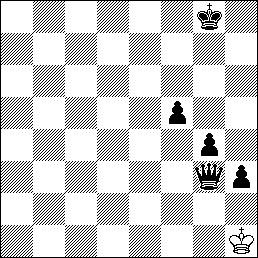
- The king is not in check.
- No legal king move exists.
- No other legal move exists.
- The result is a draw immediately.
How to avoid accidental stalemate
Most accidental stalemates happen because the winning side keeps checking blindly or tries to capture every last pawn before finishing the mate.
- Before moving, ask: Will my opponent still have at least one legal move?
- Do not rush to take the final pawn unless you have checked the legal moves.
- Build a mating net instead of giving random checks.
- If you are far ahead, centralise your king and improve your pieces first.
- When in doubt, leave one safe waiting move available until mate is ready.
Winning positions are most often spoiled by panic, haste, or habit. Stalemate is the classic example.
Threefold repetition, repeated positions, and perpetual check
Threefold repetition is about repeating the same position, not just the same moves.
Example: Fischer vs Petrosian (1971)
In this famous Candidates Final game, the same position occurred after 30.Qe2, again after 32.Qe2, and once more after 34.Qe2. Because the identical position appeared three times with the same side to move, Fischer was entitled to claim a draw by threefold repetition.
Fragment showing the repetition loop:
29... Kh7
30 Qe2 Qe5
31 Qh5 Qf6
32 Qe2 Re5
33 Qd3 Rd5
34 Qe2 (draw claimed)
The same position must appear three times with the same side to move and the same legal rights. Castling rights and en passant rights matter, so two positions that look identical are not always legally identical.
Perpetual check is a common practical way to force repetition. In modern rules it is usually recorded as repetition or agreed as a draw, not treated as a separate official draw category.
Perpetual check: a practical way to force a draw
Perpetual check is a practical drawing method where one side keeps checking so the opponent cannot escape safely.
Perpetual check is not usually treated as a separate modern draw rule. In practice, it normally becomes a draw by repetition or ends with both players agreeing to a draw.
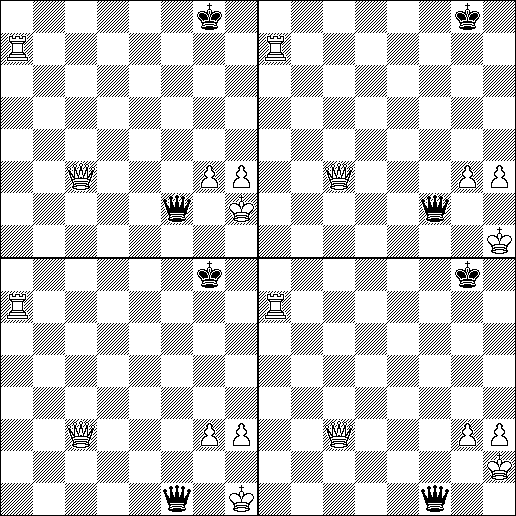
Typical checking loop:
1. Kh1 Qf1+
2. Kh2 Qf2+
3. Kh1 Qf1+
4. Kh2 Qf2+
and so on
The 50-move rule and the 75-move rule
These rules exist to stop games from dragging on forever when no real progress is being made.
The 50-move rule allows a player to claim a draw if there have been 50 moves by each side with no pawn move and no capture. In other words, if both players keep manoeuvring pieces for 50 moves each without any capture or pawn advance, either player may claim a draw.
The 75-move rule is the automatic version. If 75 moves by each side pass without any pawn move or capture, the game is automatically drawn unless the final move gives checkmate.
This rule appears most often in technical endgames, where one side tries to make progress but the defender keeps holding without allowing a capture or pawn move.
Example: Timman vs Lutz (1995)
After 69.Rxg3, there were no further captures and no pawn moves. The players continued manoeuvring their pieces in a technical endgame, which is exactly the kind of situation the 50-move rule is meant to cover.
Why this matters:
The rule does not mean a game is drawn after 50 moves total. It means a draw may be claimed after 50 moves by each side with no capture and no pawn move.
- 50-move rule = claimable draw.
- 75-move rule = automatic draw.
- Pawn moves reset the count.
- Captures reset the count.
- It is not the same thing as stalemate.
Insufficient material and dead positions
Insufficient material means there is no legal way to create checkmate from the position.
- King versus king
- King and bishop versus king
- King and knight versus king
- Some blocked positions where no legal sequence can ever lead to mate
This is why a lone bishop or a lone knight cannot beat a bare king. A draw is correct because mate is impossible, not merely difficult.
Draw by agreement
Players may agree to a draw when the position is balanced or when neither side sees a realistic path to win.
In practical chess, agreement is common in equal endgames, repeated positions, or sterile middlegames where both sides have neutralised each other.
Timeout and online draw confusion
A lot of online confusion comes from mixing stalemate, insufficient material, and timeout rules together.
If a player runs out of time, the result still depends on whether the opponent has legal mating material. If the opponent cannot possibly checkmate by any legal sequence, the result is a draw rather than a win.
That is why players sometimes see “draw by timeout vs insufficient material” online and assume something strange happened. In reality, the game was applying a normal draw principle.
Common beginner misconceptions
- Stalemate is not checkmate.
- Three repeated moves do not matter if the positions are different.
- Threefold repetition is about positions, not move notation.
- The 50-move rule is not the same as stalemate.
- Two kings left is always a draw.
- Perpetual check is usually repetition in modern rule language.
Related pages
- Checkmate vs Stalemate See the exact difference between a win by mate and a draw by stalemate.
- Stalemate in Chess More stalemate examples, traps, and practical swindles.
- The 50-Move Rule Explained A deeper look at move-count draws and tricky endgame cases.
- Drawing Techniques in Lost Endgames Learn fortress ideas, perpetual checks, and defensive resources.
Common questions about draws in chess
These answers are written to be clear on their own and to clear up the draw-rule mix-ups that catch many players.
Core definitions and quick differences
What is a draw in chess?
A draw in chess means the game ends tied, so neither player wins and each side scores half a point. A draw is the final result, while stalemate, repetition, and insufficient material are different rule paths that lead to that result. Use the quick-answer sections and visualiser above to compare the main draw types side by side.
Is stalemate a draw in chess?
Yes. Stalemate is one specific kind of draw in chess. The defining rule is that the side to move is not in check but has no legal move at all. Use the interactive draw visualiser above to see exactly how a stalemate position looks on the board.
What is the difference between stalemate and draw?
A draw is the overall tied result of a game, while stalemate is one rule that produces that tied result. Repetition, insufficient material, move-count rules, and agreement can also end a game drawn. Compare the summary boxes and the visualiser above to see how each draw route works differently.
Is stalemate the same as checkmate?
No. Stalemate is a draw, while checkmate is a win. In checkmate the king is under attack and cannot escape, but in stalemate the king is not in check and the side to move simply has no legal move. Use the stalemate visualiser and the linked comparison pages to make the distinction clearer in real positions.
Why is stalemate not a win?
Stalemate is not a win because the king is not in check. Chess awards victory for checkmate, resignation, or other valid winning conditions, but not for trapping a king that is not actually attacked. Replay the examples above and compare the final positions to see why that rule matters in practice.
How do you know if a chess game is a draw?
A chess game is a draw if one of the draw rules applies, such as stalemate, repetition, insufficient material, move-count rules, or agreement. The practical test is to check whether the position meets one of those exact rule conditions rather than guessing from the material count alone. Use the quick-answer list above as a checklist when you are unsure why a game ended tied.
What are the main ways a chess game can be drawn?
The main draw routes most players should know are stalemate, threefold repetition, insufficient material, the 50-move rule, the 75-move rule, and draw by agreement. Perpetual check is also a common practical drawing method because it usually leads to repetition. Use the card section and replay examples above to connect each draw rule to a real board situation.
What does draw by stalemate mean?
Draw by stalemate means the game ended tied because the side to move had no legal move and was not in check. That is a board-position rule, not a timeout rule or a repetition rule. Use the stalemate board above to see the exact pattern that creates this result.
Stalemate rules and common stalemate confusion
What is stalemate in chess?
Stalemate in chess is a position where the side to move has no legal move and its king is not in check. That single rule ends the game immediately as a draw even if one side has a huge material advantage. Use the visualiser above to inspect the legal-move problem that makes stalemate different from mate.
What are the official stalemate rules in chess?
The official stalemate rule is that if the player to move has no legal move and is not in check, the game is drawn. The important detail is that the absence of legal moves matters only when the king is safe from direct attack. Use the visual board and the quick checklist above to test whether a position is really stalemate.
Does stalemate mean draw?
Yes. Stalemate means the result is a draw. It does not mean repetition, and it does not mean the winning side somehow missed a checkmate by rule definition alone. Use the draw-type comparison sections above to separate stalemate from the other common drawn endings.
Can you stalemate someone while you are winning?
Yes. A player with a completely winning position can still throw away the win by allowing stalemate. This happens most often when the stronger side keeps checking carelessly or removes the opponent’s last legal move too early. Use the avoid-stalemate visualiser scene above to practise spotting that danger before simplifying.
Why do beginners keep getting stalemate by accident?
Beginners often get accidental stalemate because they focus on surrounding the king instead of checking whether the opponent still has a legal move. Queen endgames and basic clean-up positions are especially dangerous because the stronger side can cover every escape square without giving check. Use the avoid-stalemate section and board visualiser above to train the habit of checking for one remaining legal move.
How do you avoid accidental stalemate?
You avoid accidental stalemate by checking whether your move leaves the defending side at least one legal move. The key practical habit is to build a mating net calmly instead of giving random checks or grabbing every last pawn. Use the avoid-stalemate scene and the clean-up tips above to practise safer winning technique.
Can stalemate happen in the middlegame?
Yes. Stalemate can happen in the middlegame, even though it is much more common in endgames. The rule depends only on legal moves and king safety, not on the phase of the game or the number of pieces left. Use the page examples and visual board logic above to judge positions by legal moves rather than by appearance.
Is it unsporting to play for stalemate when you are losing?
No. Playing for stalemate when you are losing is completely legitimate chess. Stalemate is a normal defensive resource built into the rules, and many strong defenders save half a point that way. Use the stalemate explanation and defensive examples on this page to spot those saving chances more quickly.
Repetition, perpetual check, and repeated-move confusion
What is threefold repetition?
Threefold repetition is when the same position appears three times with the same side to move and the same legal rights, allowing a player to claim a draw. The rule is about repeating a full position, not merely repeating one move or one checking idea. Replay the Fischer–Petrosian fragment above to see a clean repetition example move by move.
Does threefold repetition have to be consecutive?
No. Threefold repetition does not have to happen on consecutive moves. What matters is that the same position returns three times with the same player to move and the same legal rights. Use the repetition example above to see how a position can come back through a short loop rather than through a single repeated pair of moves.
How many repeated moves in chess before a draw?
A draw is not based on repeated moves but on repeated positions. The real rule is that the same position must appear three times with the same side to move and the same legal rights before a draw can be claimed by threefold repetition. Use the repetition section above to focus on whole-board identity rather than on move notation alone.
How many repeated positions cause a draw in chess?
Three repeated positions can allow a player to claim a draw by threefold repetition. Modern rules also recognise automatic fivefold repetition even without a claim. Replay the repetition fragment above and compare the board state carefully to see what actually has to match.
Is stalemate the same as repetition in chess?
No. Stalemate and repetition are different draw rules. Stalemate happens when the side to move has no legal move and is not in check, while repetition happens when the same position returns with the same side to move and the same legal rights. Use the visualiser and replay section above to compare a frozen position with a repeating loop.
Is perpetual check an official draw rule?
Perpetual check is not usually treated as a separate modern draw rule. In practice it normally becomes a draw by repetition or ends as a draw by agreement because the checking side can keep forcing the same defensive responses. Use the perpetual-check explanation and repetition replay above to see how the drawing mechanism usually works.
Can repeated checks cause stalemate?
No. Repeated checks do not create stalemate by themselves. Stalemate requires no legal move and no check, while repeated checks usually point toward repetition, perpetual check, or a mating attack instead. Use the two draw sections above to keep the ideas of no-legal-move and repeated-position clearly separate.
Do the positions have to be exactly the same for repetition?
Yes. The positions must be legally identical for repetition to count. That means the same side must be to move and the same legal rights, such as castling rights or en passant possibilities, must still exist. Use the repetition explanation above to judge full legal identity, not just piece placement.
Move-count rules, insufficient material, and other draw routes
What is the 50-move rule in chess?
The 50-move rule allows a player to claim a draw if each side has made fifty moves without any pawn move and without any capture. A single capture or pawn advance resets the count completely, which is why the rule matters most in technical endgames. Replay the Timman–Lutz fragment above to see the kind of long manoeuvring phase this rule is designed to stop.
What is the 75-move rule in chess?
The 75-move rule is the automatic version of the move-count draw rule. If each side completes seventy-five moves with no pawn move and no capture, the game is automatically drawn unless the final move gives checkmate. Use the move-count section above to see how this rule differs from a draw that must be claimed.
How many moves without a capture or pawn move is a draw in chess?
A player may claim a draw after 50 moves by each side without a pawn move or capture, and the game becomes automatically drawn after 75 such moves by each side unless the final move checkmates. The rule is about progress markers, not about the total number of moves in the game. Use the move-count examples above to connect the number to a real endgame situation.
Is the 50-move rule the same as stalemate?
No. The 50-move rule is a move-count draw rule, while stalemate is a board position where the side to move has no legal move and is not in check. They are completely different mechanisms even though both end with a draw. Use the visualiser and replay sections above to compare a frozen legal position with a long no-progress sequence.
What is insufficient material in chess?
Insufficient material means there is no legal way to create checkmate from the position. Standard examples include king versus king, king and bishop versus king, and king and knight versus king. Use the insufficient-material visualiser scene above to connect the rule to a concrete board pattern.
Is king and bishop versus king a draw?
Yes. King and bishop versus king is a draw because a lone bishop cannot force checkmate with only its king. The bishop controls only one colour complex, which leaves too many escape options for a bare king. Use the insufficient-material visualiser above to see this standard drawing material balance.
Is king and knight versus king a draw?
Yes. King and knight versus king is a draw because a lone knight cannot force checkmate with only its king. The knight does not control enough key squares at once to complete a mating net by itself. Use the insufficient-material explanation above when checking whether a material edge is actually winning.
Is a game drawn when only two kings are left?
Yes. King versus king is an immediate draw because checkmate is impossible. No legal sequence of moves can change that basic fact into a winning position. Use the insufficient-material section above to group this with the other standard no-mate endings.
Can players agree to a draw?
Yes. Players can agree to a draw. This usually happens in balanced positions, repeated positions, or endgames where neither side sees realistic winning chances. Use the main draw-routes section above to place agreement alongside the other formal ways a game can finish tied.
Can you lose on time if your opponent cannot mate you?
Under standard rules, if your opponent runs out of time but you have no legal way to checkmate by any possible sequence of legal moves, the game is drawn rather than won. That is why some online results show a timeout draw combined with insufficient material logic. Use the timeout explanation above to separate this case from stalemate and repetition.
Practical judgement and common myths
Why do winning players still draw games in simple endgames?
Winning players still draw simple endgames because conversion requires care, not just extra material. The usual causes are stalemate tricks, repetition, bad king placement, and rushing instead of improving the position step by step. Use the anti-stalemate advice and replay examples above to turn won positions into safer technical wins.
Is a draw a bad result in chess?
No. A draw is not automatically a bad result in chess. Sometimes it is a missed win, but in other cases it is a good defensive save or the fair result of an equal position. Use the page examples above to judge the reason for the draw before deciding whether it was a mistake or a success.
Is it true that perfect chess is a draw?
Perfect chess is widely believed to be a draw, but chess has not been fully solved. That big theoretical idea matters far less to most players than understanding the real over-the-board draw rules and defensive resources that appear in normal games. Use the rule summaries and examples on this page to improve practical results instead of abstract debate.